Cine long-axis imaging
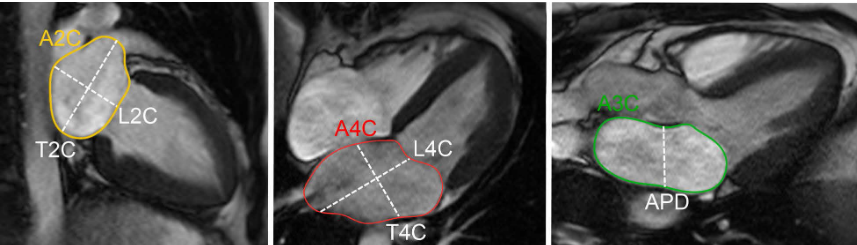
Cine long-axis CMR provides CardiacNexus measurements for atrial structure, atrial function, long-axis strain, atrioventricular plane displacement, and mitral/tricuspid annular geometry.
- Modality
- Cine long-axis CMR
- UKB source
- Data Field 20208
- Pipeline step
- 2-chamber and 4-chamber atrial segmentation, long-axis strain extraction, ECG-aware atrial timing, and combined ventricular-atrial features
- Outputs
- atrial_volume.csv, strain_lax.csv, ventricular_atrial_feature.csv, timeseries/atrium.npz, timeseries/strain_lax.npz, long-axis QC plots
- Maturity
- Source-audited modality page
Current pipeline role
The atrial route reads long-axis 2-chamber and 4-chamber images/segmentations, runs atrial QC, computes biplane LA volume and 4-chamber RA volume, writes atrial structure/function rows, and stores timeseries/atrium.npz. When ECG-derived pre-atrial-contraction timing is available and passes internal timing checks, it also writes booster/conduit rows and updates the atrial time-series file with LA: T_pre_a.
The long-axis strain route uses long-axis contours and the ventricular ES frame from timeseries/ventricle.npz to derive longitudinal strain and strain-rate rows in strain_lax.csv. The combined-feature route uses 4-chamber segmentation and ventricular/atrial aggregates to derive AVPD, annular diameters, IPVT, and atrial-contribution rows.
Current outputs
| Output family | Current rows | Source path | Notes |
|---|---|---|---|
| Atrial structure and function | LA/RA dimensions, areas, volumes, expansion/emptying rows, PER rows, pre-A rows when available | src/feature_extraction/Long_Axis_20208/eval_atrial_volume.py | ECG timing controls booster/conduit rows |
| Long-axis strain | global longitudinal strain, strain-rate, timing, dispersion, post-systolic and pre-systolic rows | src/feature_extraction/Long_Axis_20208/eval_strain_lax.py | requires LA QC and ventricular timing |
| Combined features | AVPD, IPVT, atrial contribution, mitral/tricuspid annular rows | src/feature_extraction/Combined_Features/eval_ventricular_atrial_feature.py | mixed artifact documented across cross-chamber and valvular pages |
| Time series and QC | timeseries/atrium.npz, timeseries/strain_lax.npz, atrial and strain plots | implementation sources above | subject-level diagnostics for timing and segmentation review |
QC and interpretation caveats
Long-axis rows are sensitive to view prescription, atrial boundary definition, pulmonary-vein and appendage exclusion, segmentation quality, annular landmarks, and ECG timing. Atrial measurements and long-axis strain also inherit ventricular timing dependencies when they use LV ES or pre-atrial-contraction frames.
Long-axis output families should remain separated by purpose: atrial structure/function rows, longitudinal strain rows, and cross-chamber/annular rows answer different clinical questions and have different missingness behavior.
Source audit
- Atrial input dependencies, QC calls, time-series keys, visualizations, BSA/indexing behavior, and pre-atrial-contraction handling were checked against
eval_atrial_volume.py. - Long-axis strain output families and ventricular ES dependency were checked against
eval_strain_lax.py. - Cross-chamber and annular rows were checked against
eval_ventricular_atrial_feature.py. - Textbook context boundary: broad clinical textbook context is not surfaced here because page-specific implementation and linked phenotype pages are sufficient for draft rollout.
- Displayed figure provenance is recorded in
docs/data/figure_provenance.yml; permission and exact reuse wording remain pending for public release.