Cine short-axis imaging
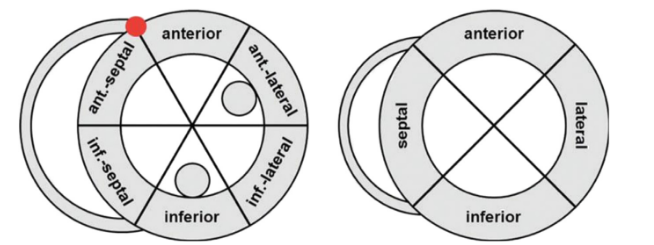
Cine short-axis CMR is the CardiacNexus backbone for ventricular structure, ventricular function, myocardial mass/wall thickness, and short-axis mechanics.
- Modality
- Cine short-axis CMR
- UKB source
- Data Field 20209
- Pipeline step
- Short-axis ventricular segmentation, ED/ES timing, volume/mass/function extraction, and SAX strain/torsion analysis
- Outputs
- ventricular_volume.csv, strain_sax.csv, timeseries/ventricle.npz, timeseries/strain_sax.npz, ventricular and strain QC plots
- Maturity
- Source-audited modality page
Current pipeline role
The ventricular-volume route reads sa.nii.gz and seg_sa.nii.gz, requires short-axis QC, defines ED as frame 0 for retrospectively gated bSSFP, and defines ES as the minimum LV volume frame. It writes LV/RV volumes, myocardial mass, stroke volume, ejection fraction, cardiac output/index, BSA-indexed rows, selected diameters, sphericity indices, filling-rate rows, and timeseries/ventricle.npz.
The short-axis strain route reads SAX strain inputs and ventricular timing, writes strain_sax.csv, stores timeseries/strain_sax.npz, and generates circumferential/radial strain, strain-rate, timing, diastolic index, torsion, and recoil outputs when the required contours and peak detection are available.
Current outputs
| Output family | Current rows | Source path | Notes |
|---|---|---|---|
| Ventricular structure | EDV/ESV, indexed volumes, LV diameters, sphericity rows | src/feature_extraction/Short_Axis_20209/eval_ventricular_volume.py | ED frame is fixed at 0; ES is minimum LV volume |
| Ventricular function | stroke volume, EF, cardiac output, cardiac index, filling-rate rows | eval_ventricular_volume.py | filling-rate rows depend on volume-curve peak detection |
| Myocardial mass and wall thickness | myocardial mass, mass index, M/V, wall thickness/thickening and related rows | eval_ventricular_volume.py | segmentation and geometry-sensitive |
| SAX mechanics | circumferential/radial strain, strain-rate, timing, diastolic index, torsion, recoil | src/feature_extraction/Short_Axis_20209/eval_strain_sax.py | deformation-sensitive; requires backend/QC caveats |
| Time series and QC | timeseries/ventricle.npz, timeseries/strain_sax.npz, ED/ES overlays, strain plots | implementation sources above | used by downstream LAX, flow, and combined features |
QC and interpretation caveats
Short-axis rows depend on segmentation quality, basal/apical slice handling, voxel geometry, ED/ES frame selection, BSA availability, ECG overlays when used, and derivative peak detection. Volume and mass rows are more mature than deformation-sensitive strain/torsion rows.
Short-axis timing is reused by other modality routes. If timeseries/ventricle.npz is missing or inconsistent, long-axis strain, phase-contrast timing cross-checks, and combined cross-chamber rows may fail or be skipped.
Source audit
- Ventricular ED/ES definitions, output families, BSA/indexing behavior, time-series keys, and QC plots were checked against
eval_ventricular_volume.py. - SAX strain, strain-rate, timing, torsion, recoil, and QC plot families were checked against
eval_strain_sax.py. docs/data/output_column_inventory.ymlrecords theventricular_volumeandstrain_saxartifact contracts.- Textbook context boundary: broad clinical textbook context is not surfaced here because implementation and linked phenotype pages are sufficient for draft rollout.
- Displayed figure provenance is recorded in
docs/data/figure_provenance.yml; permission and exact reuse wording remain pending for public release.